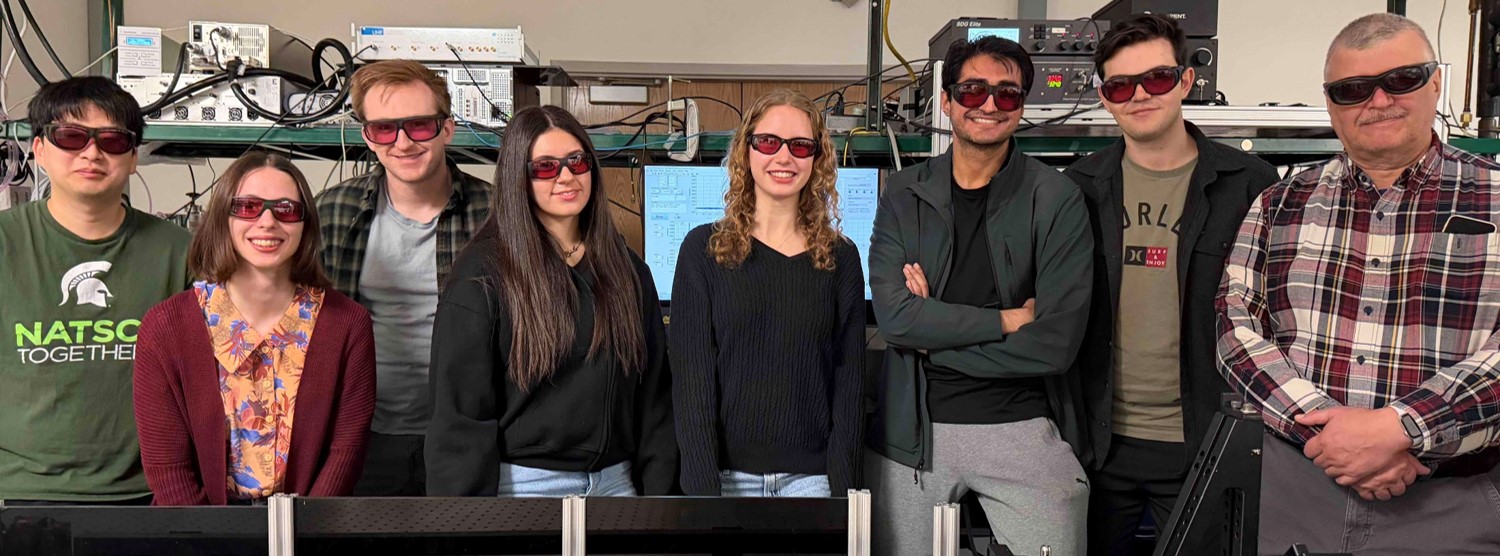
The Dantus Research Group, 2026.
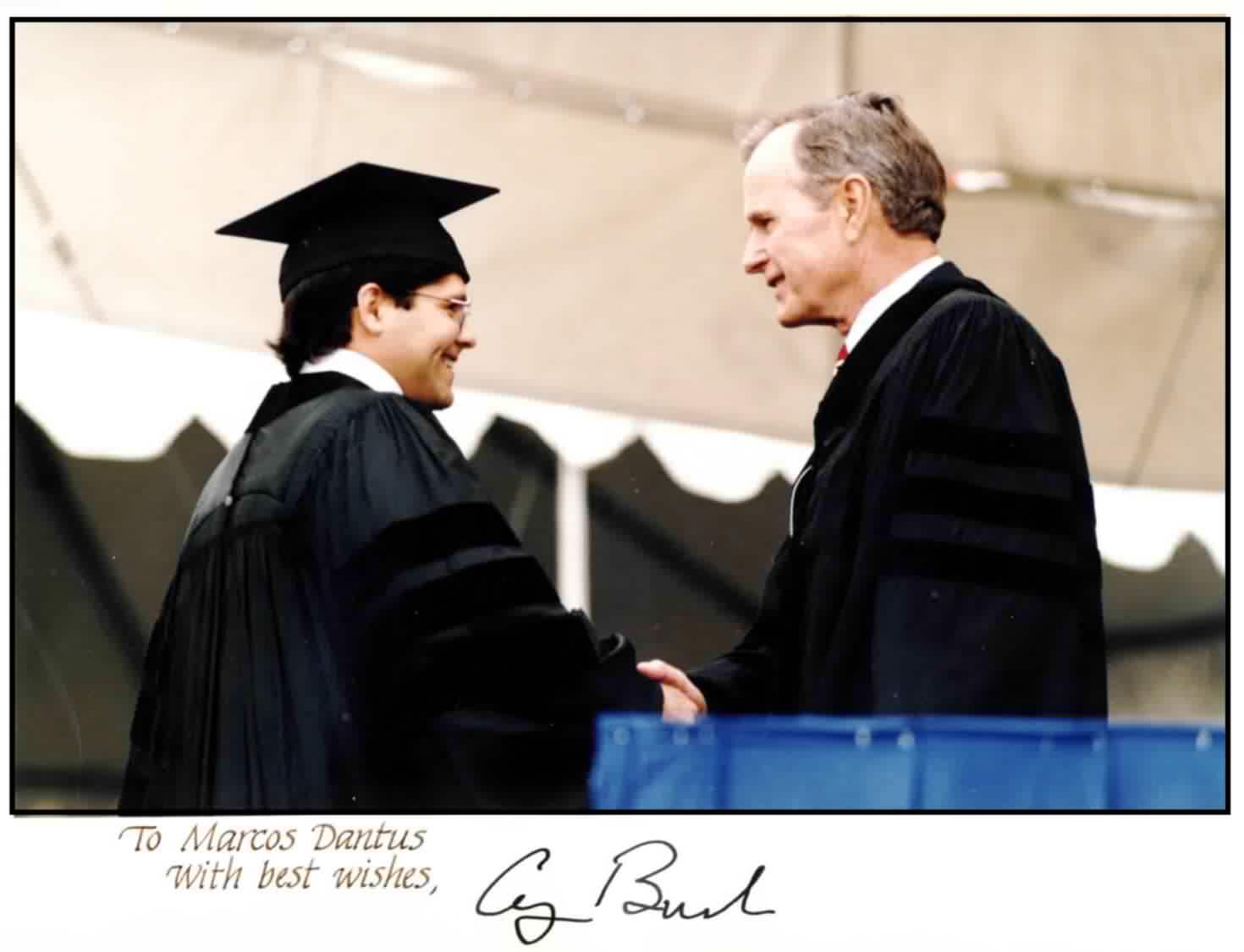
Dantus receives the Milton and Francis Clauser Doctoral Prize,
California Institute of Technology, from President George H. W. Bush, 1991.
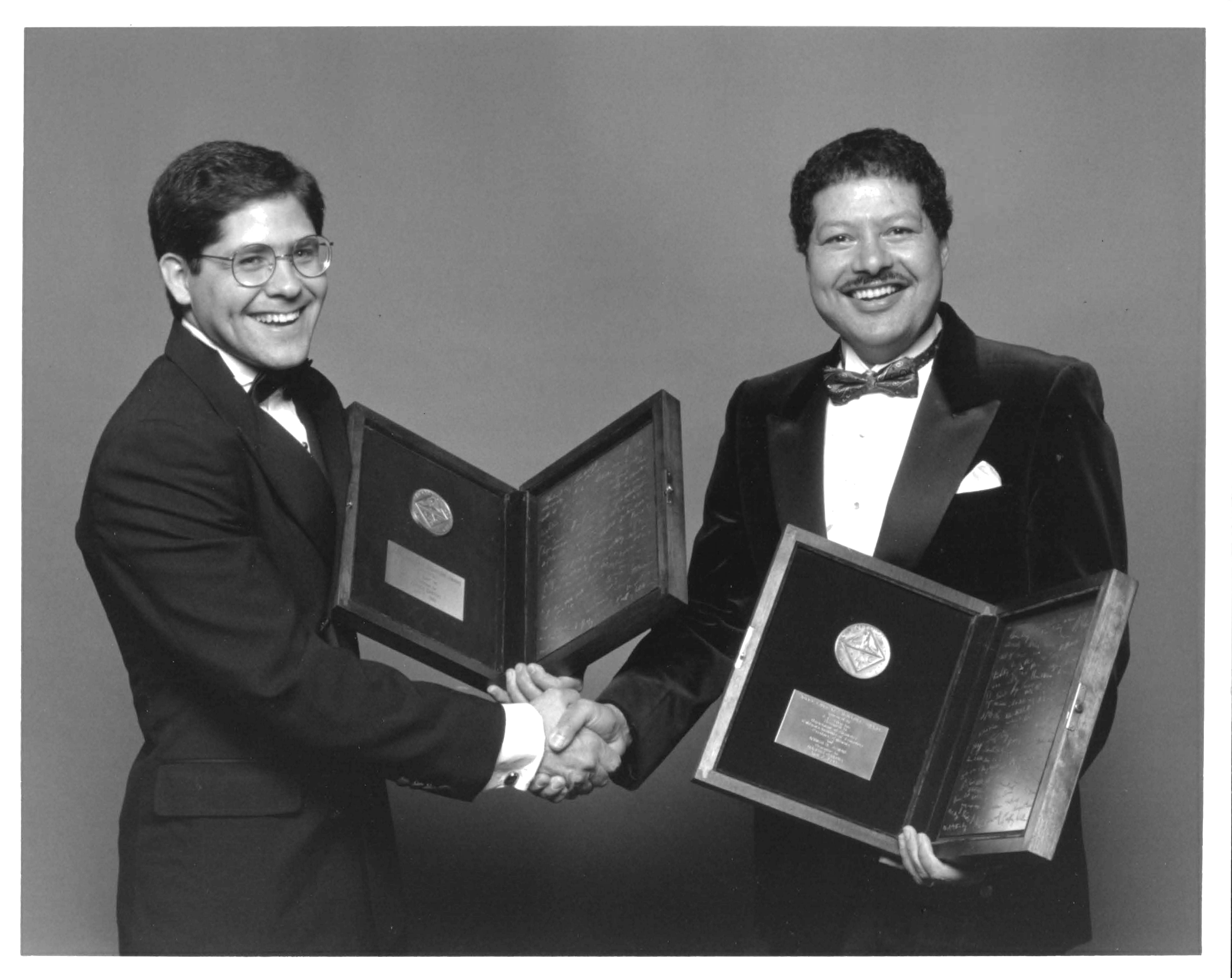
Dantus receives the ACS Nobel Laureate Signature Award, with Prof. Ahmed H. Zewail, 1992.
News and Announcements:
The Dantus research group at Michigan State University expects to recruit up to three PhD students in the Fall of 2026. All PhD students receive full financial support that combines research assistantship and teaching assistantship. Students from all countries are welcome to apply.
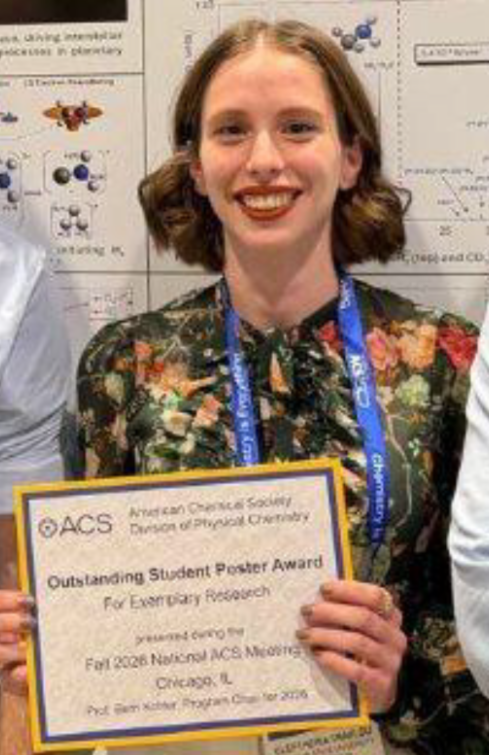
We congratulate our student Eleftheria Travlou for receiving a 2026 ACS Fall Outstanding Poster Award.
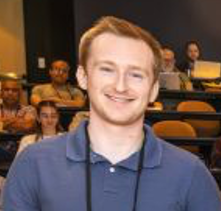
We congratulate our student Jacob Stamm for receiving a 2025 SSRL/LCLS Users’ Meeting Poster Award.
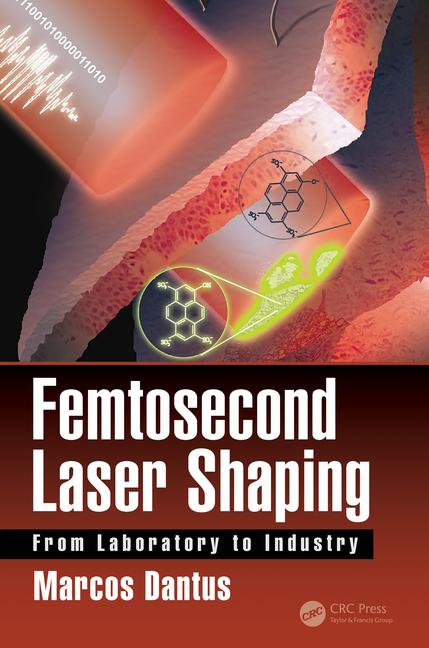
Book on Femtosecond Laser Shaping by Prof. Dantus
Prof. Dantus Google Scholar profile link
Research Interests
Physical Chemistry · Chemical Physics · Laser-Matter Interactions
Ultrafast Electron-Driven Chemistry
We investigate electron-impact and electron-induced chemistry with femtosecond time resolution. By tracking reactions in real time, we identify exotic mechanisms including bond rearrangements and roaming prior to full energy redistribution. A central challenge is extracting mechanisms and timescales across up to 100 competing product channels and connecting them to the underlying electronic structure.
Applications include radiation damage in biomolecular building blocks, mass spectrometry, and the ion chemistry underlying extreme-ultraviolet (EUV) photolithography.
Ultrafast Charge-Driven Chemistry in Molecular Clusters
Weakly bound molecular clusters serve as controllable reaction complexes that bridge isolated molecules and condensed-phase environments. Site-selective ionization launches a radical cation toward a neighboring molecule with tunable kinetic energy, enabling direct observation of charge transfer, proton transfer, and bond rearrangement on femtosecond timescales.
The key challenge is determining how local structure and microsolvation govern the earliest branching between energy redistribution, reaction, and fragmentation, and identifying when dynamics become nonstatistical. This work informs radiation and plasma chemistry, interfacial and aerosol reactivity, charge-initiated transformations relevant to biomolecular damage and materials processing, and provides stringent benchmarks for electronic-structure and nonadiabatic-dynamics simulations.
Strong-Field Ionization in Polyatomic Molecules
We seek to determine which strong-field pathways: multiphoton ionization, tunneling, and electron recollision, dominate in complex molecules and how they can be controlled. The central challenge is linking the ionization step to where energy is deposited within the molecule and how that energy dictates fragmentation and chemistry.
Our goal is a predictive, controllable description of strong-field ionization that identifies when common simplifying models fail and which variables truly control outcomes, enabling femtosecond-scale control of fragmentation and reaction pathways before energy redistribution or collisions occur.
Phase Characterization and Adaptive Pulse Shaping
We develop precision spectral-phase metrology and adaptive pulse shaping techniques to generate shorter, cleaner, and more controllable femtosecond laser pulses, including methods compatible with high-power operation.
The key challenge is rapid, robust phase measurement and correction that enables regimes such as sub-5-fs pulses, high-contrast excitation at peak intensities up to 1018 W/cm2, and advanced coincidence or ion-imaging experiments. These capabilities support our strong-field and reaction-dynamics programs and open opportunities in microscopy, next-generation photonics, optical computing, and sensing.