Research
Synopsis
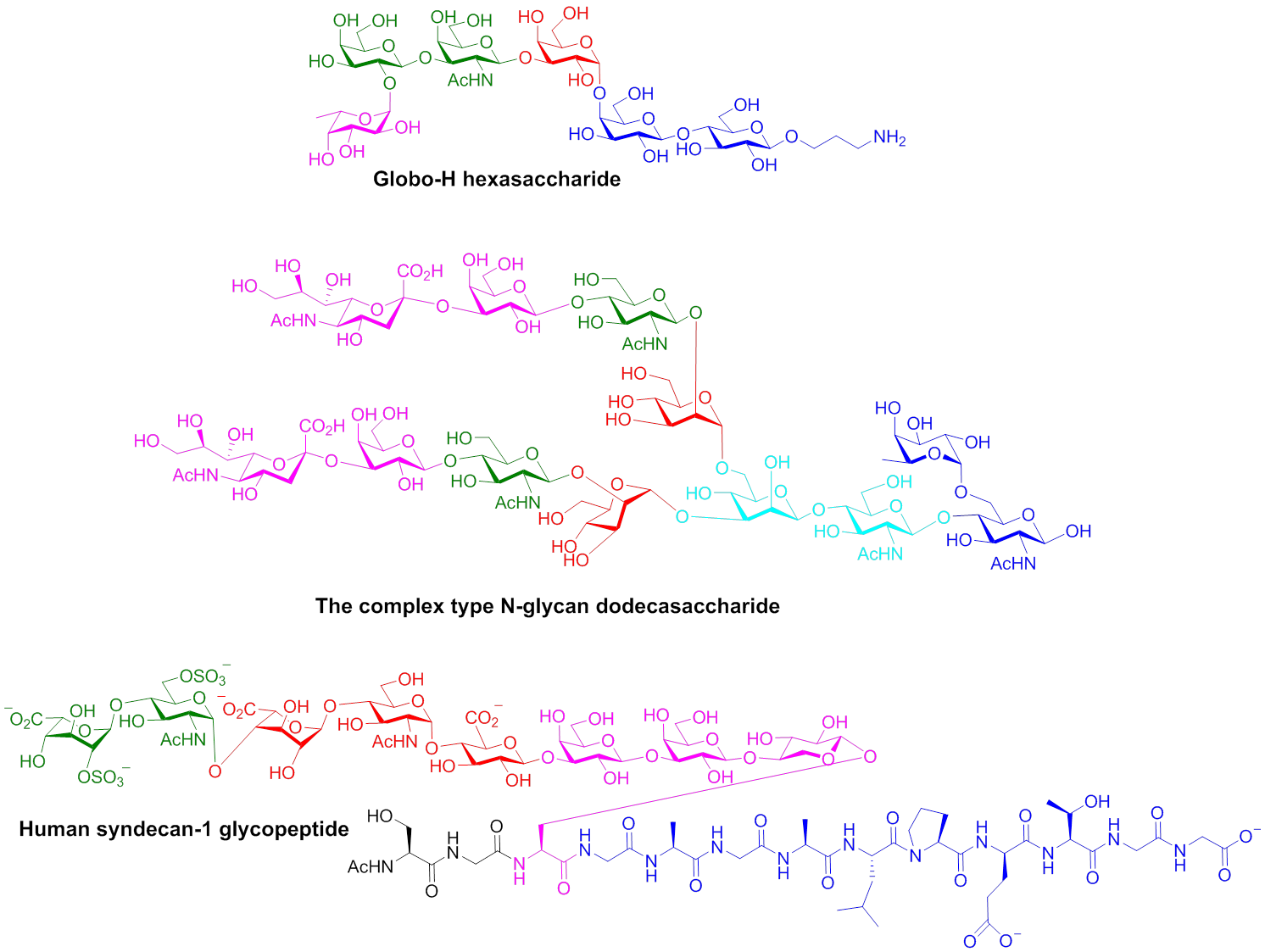
The major emphasis of our research is on chemistry and biology of carbohydrates. Carbohydrates play important roles in many biological processes such as inflammation, tumor metastasis, bacterial and viral infections. While the biological and medicinal importance of complex carbohydrates and glyco-conjugates have been widely recognized, many of the molecular details of how these compounds mediate their functions remain to be elucidated. Building on our strength in synthetic chemistry, we take a multi-disciplinary approach to study this important class of molecules. Our research encompasses several areas including:
Synthetic chemistry/physical organic chemistry
Nanoscience
Immunology
Students and postdocs in our group are exposed to a
wide variety of state-of-the-art research topics including organic
synthesis, physical organic chemistry, nanotechnology, materials
science, molecular biology, immunology, cancer biology and vascular
biology. This is an exciting scientific journey!
Synthetic chemistry/physical Organic Chemistry
In the synthetic area, we have been actively developing novel methodologies for assembling biologically active oligosaccharides. Traditional carbohydrate synthesis is quite tedious and time-consuming. In order to expedite the synthetic process, we have developed two one-pot glycosylation methodologies, where multiple sequential glycosylation reactions are carried out in a single reaction flask to yield desired oligosaccharides without time-consuming intermediate purifications.
The traditional one-pot oligosaccharide synthesis methodologies rely on differential anomeric reactivities of glycosyl donors through judicious positioning of protective groups on the glycon ring with appropriate deactivating power. The glycosyl donors must possess higher anomeric reactivities than the acceptors for selective donor activation. Although this methodology has been successfully applied in syntheses of complex oligosaccharides, due to its reactivity dependent nature, it is necessary to prepare a large number of building blocks with suitable anomeric reactivities, which is a serious disadvantage.
To address the afore-mentioned shortcoming of the traditional one pot synthesis, in the first methodology we have developed, we have demonstrated that by simply modifying the aglycon substituent, multiple levels of anomeric reactivities (Figure 1) can be generated allowing chemoselective one pot synthesis (Figure 2). Moreover, we have designed our synthetic routes so that building blocks with multiple levels of reactivity can be divergently derived from a common intermediate (Figure 1), thus greatly reducing the amount of time necessary for building block preparation.
While the aglycon tuning method reduces the amount of time and efforts to generate suitable building blocks, it would be more desirable if the one-pot synthesis can be performed without the requirement that the donor must be more reactive than the acceptor. In order to accomplish this, we have developed a second method, the pre-activation based iterative one-pot glycosylation (Figure 3). In this approach, the thioglycoside glycosyl donor is activated by a stoichiometric promoter such as p-TolSCl/AgOTf in the absence of an acceptor, generating a reactive intermediate. Upon completion of the activation, the acceptor is then added, which reacts with the intermediate to form the desired oligosaccharide product. As donor activation and glycosylation are performed in two distinctive steps, the donor and acceptor do not need to possess differential reactivities, thus granting much freedom in building block selection and significantly improving overall synthetic efficiencies.
As an example of the pre-activation based method, the tumor associated
carbohydrate antigen Globo-H hexasaccharide was assembled in 47%
overall yield in one pot within six hours starting from mono- and
di-saccharide building blocks (Figure 4).
Besides
Globo-H,
we
have
applied
this
method
to
the
assembly of a wide range of complex
oligosaccharides, including the complex type N-glycan dodecasaccharide,
hyaluronic acid decasaccharide, and dimeric LewisX octasaccharide. The
high synthetic efficiency achieved using our pre-activation based one
pot method bodes well for future adaptation into automated synthesis,
which complements with the current solid phase based automated
synthesis method.
Figure
4. One-pot synthesis of Globo-H hexasaccharide.
Besides synthesis, we are also performing mechanistic studies of the
glycosylation reactions. We believe that a thorough understanding of
the mechanism is crucial for further improvement of the glycosylation
reactions. Through a series of low temperature NMR and isotope labeling
studies, the structures of the reactive intermediates formed upon
pre-activation were determined. It was found that for a donor with
multiple electron withdrawing groups, the glycosyl triflate was formed
following pre-activation, while the dioxalenium ion was the major
intermediate with a donor bearing electron donating protective groups.
The inherent internal energy difference between these reactive
intermediates and the associated oxacarbenium ion like transition
states during nucleophilic attack by the acceptor can explain the
observed difference between these two types of donors in the
pre-activation based glycosylation reactions. Further mechanistic
studies are ongoing to enhance our knowledge of this important reaction.
Glyco-nanoscience
The unique properties of magnetic nanoparticles and diverse carbohydrate bioactivities prompt us to investigate magnetic glyco-nanoparticles (MGNP). Many pathogens use mammalian cell surface carbohydrates as anchors for attachments, which can be used for pathogen detection. One challenge for this approach is that the affinity of a carbohydrate with its receptor is often very low, in the range of mM. We envisioned that this difficulty can be overcome by presenting multiple copies of the carbohydrates on MGNP surface. Through the multivalence effect, MGNPs would have much higher avidity with the carbohydrate receptors. Indeed, we found MGNPs interacted strongly with carbohydrate binding strains of Escherichia coli (E. coli), allowing us to rapidly detect the presence of the pathogens (Figure 5). Moreover, due to the magnetic nature of the particles, the pathogen/MGNP aggregates were readily removed through a simple magnet induced separation, presenting an attractive method for pathogen decontamination.
Cancer is a complex group of diseases that affect the lives of millions
of people worldwide. The enormous heterogeneity and complexity of this
disease spurs the continual search for simple and fast methods to
analyze tumor cells and to distinguish cancer cells from normal cells,
which can greatly benefit cancer treatment and improve the clinical
outcomes for patients. We hypothesized that carbohydrate receptor
interactions can be used to detect and differentiate cancer cells.
Using an array of MGNPs bearing five different types of monosaccharides
including galactose, mannose, sialic acid, N-acetyl glucosamine and
fucose, we were able to not only detect and profile cancer cells but
also quantitatively evaluate their carbohydrate binding abilities by
magnetic resonance imaging (MRI) (Figure
6). A range of cells including
closely related isogenic tumor cells, cells with different metastatic
potential and malignant vs normal cells can be readily distinguished
based on their respective carbohydrate binding signatures. Furthermore,
the information obtained from such studies helped guide the
establishment of strongly binding MGNPs as anti-adhesive agents against
tumors. As the interactions between glyco-conjugates and endogenous
lectins present on cancer cell surface are crucial for cancer
development and metastasis, the ability to characterize and unlock the
glyco-code of individual cell lines can facilitate both the
understanding of the roles of carbohydrates as well as the expansion of
diagnostic and therapeutic tools for cancer. In addition, with the
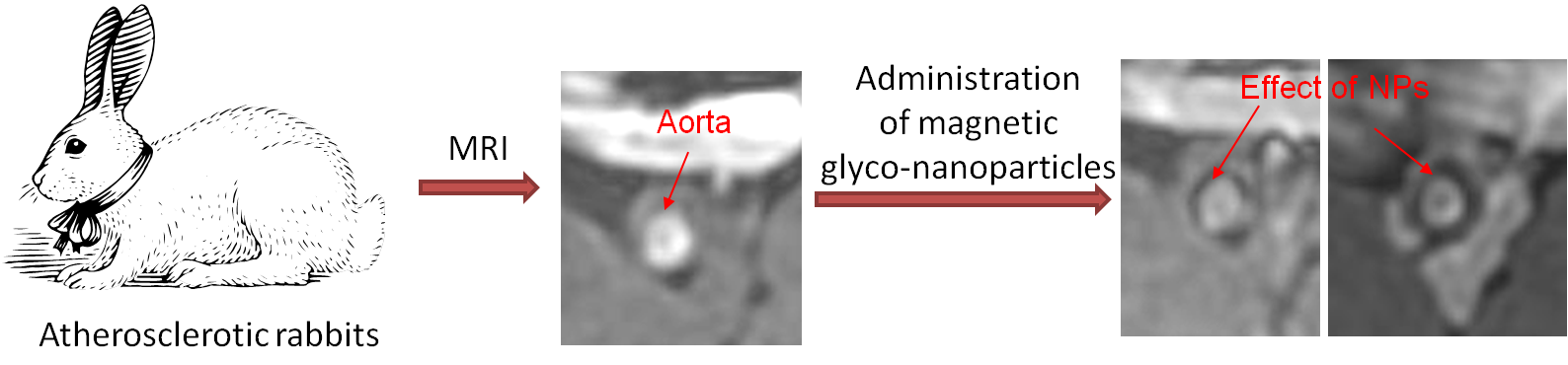
super-paramagnetic nature of the MGNPs, they can be used as MRI
contrast agents for in vivo detection. We are actively developing this
technology for non-invasive detection of diseases such as cancer,
atherosclerosis and Alzheimer’s disease.
Immunology
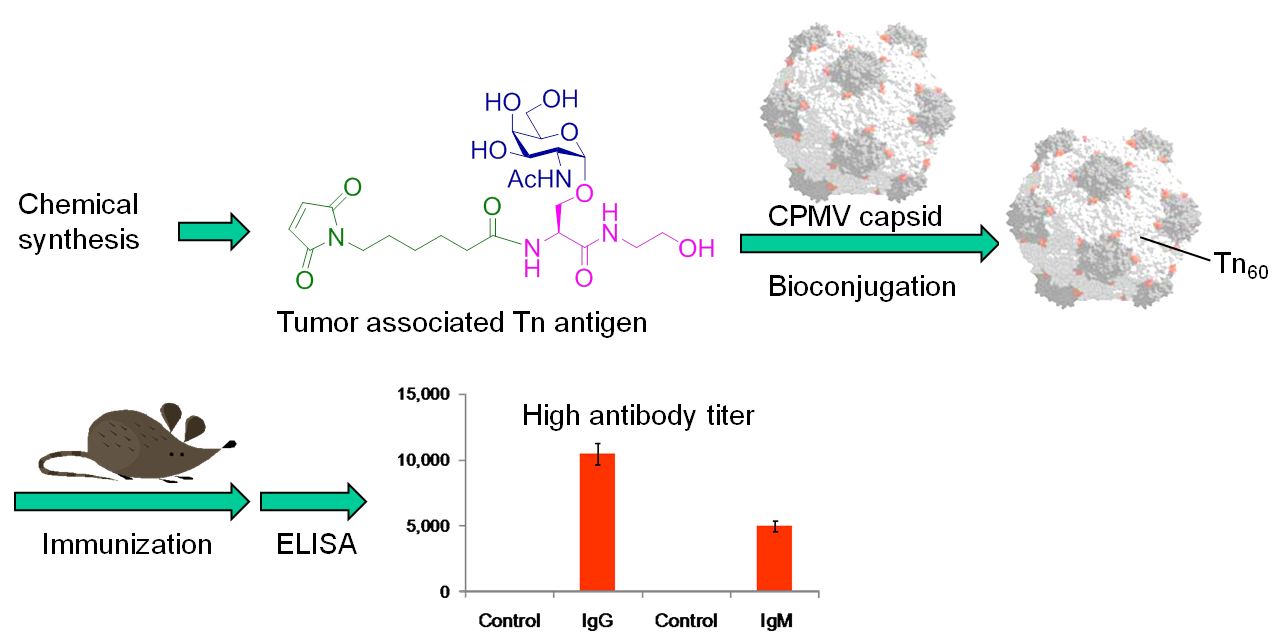
It is well known that many tumor cells have unique carbohydrate structures over-expressed on the cell surface. Immunotherapy targeting these carbohydrate antigens is a promising approach for cancer treatment. However, the low immunogenecity of carbohydrates presents a formidable challenge. To overcome this obstacle, we are investigating novel methods to boost the immune responses against carbohydrates. Cowpea mosaic virus (CPMV) is a highly immunogenic plant virus, which is not infectious to humans. The outer shell of CPMV contains sixty copies of identical protein subunits arranged in highly organized icosahedra geometry. We have synthesized a prototypical tumor associated carbohydrate antigen (Tn) and conjugated it to CPMV (Figure 7). The glyco-conjugate was injected into mice and pre- and post-immune antibody levels in the mice sera were measured by enzyme linked immunosorbant assays (ELISA). High total antibody titers and, more importantly, high IgG titers specific for Tn were obtained in the post-immune serum. Furthermore, the antibodies generated were able to recognize Tn antigens presented in their native conformations on the surfaces of breast cancer cells. These results suggest that the ordered display of carbohydrate antigens on CPMV capsid can greatly enhance the immunogenicity of weak antigens such as Tn. We are continuing to investigate this strategy as an excitingly new direction for the development of carbohydrate based anti-cancer vaccines.